excerpts out of the 3rd (2.reprint) and 5th Edition of the catalog (© STEAMBOAT MUELLER)
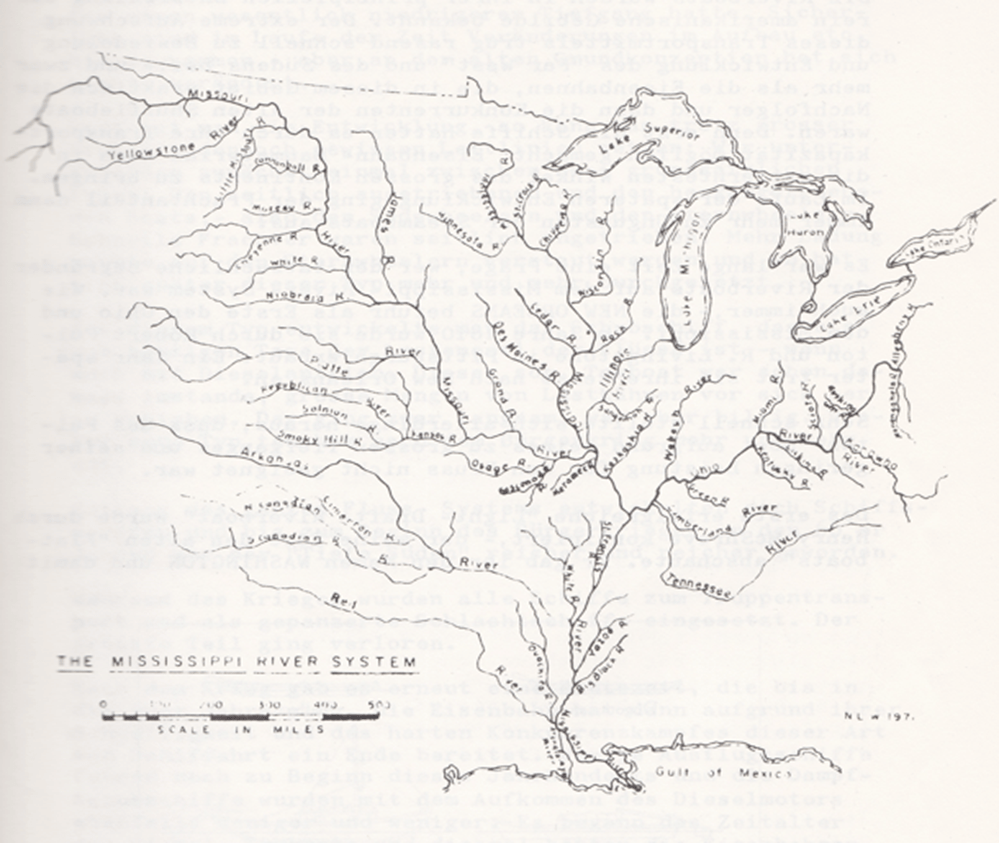
The Mississippi- River- System is widely ramified and whole books have been written about the history of his conquest. And this story shows the whole blaze of color of the young continent. It was an only adventure. And, maybe in the steamboats models, that all our modelers loves that much, is a reflection of that big country, the big width and a breeze of that adventure AMERICA.
However: The beginning of the steamboating was on the rivers in the back country oft the north atlantic coast. As an example for that may apply the HUDSON- RIVER. But very quickly the steamboating was transfered to the waterways of the midland.
The Riverboats became in their principle development famous as pure american constructions. The extreme
boom of this transport medium contributed the very fast settlement of the „Far West“ and the south, – and for sure more than the railways, which became the successors and later the competitors of the old shuffleboats. Because first the boats with their transport capacity made it possible, to bring railway- buildingmaterial even to the most distanced corners of this big continent. During the later development the
freight rates decreased more and more to the disadvantage of the Steamboats.
The year 1811 brings a series of extraordinary events, beginning with the flood, which is stronger than usual, then comes the comet that can be seen in the night sky for weeks and which the people of the river say does not bring any good. Finally, in autumn, an earthquake follows that causes devastating damage and even affects the course of the „Ol`Man River“.
But it is also the year in which the first steamboat appeared in the River- Valley. The boat is named NEW ORLEANS. It is built in the style of the steamboats of the north. On January 12, 1812, coming from Pittsburgh, it reached New Orleans on the Gulf of Mexico.
Nicholas J. Roosevelt, the captain of the boat, is the represantative of Robert Livingstone and Robert Fulton, who hold the steamshipping monopoly on the Hudson River. The same is planned for the MIssissippi and its tributaries.
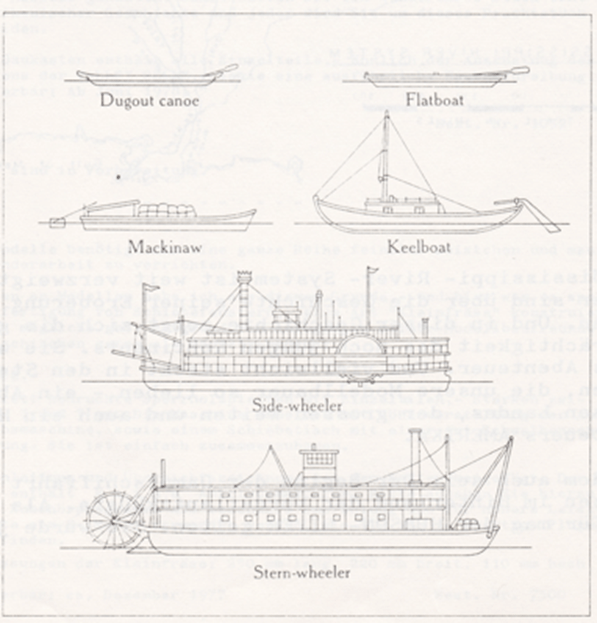
The era of the Flatboats, Mackinaws and Keelboats is comin to an end. Since the wave of immigration, they have served as a means of transport alongside the canoe. Their owners have adapted to the rigors of the overgrown and pristine river courses. Sandbars, today here, tomorrow there, driftwood islands, tree trunks, snages, rapids, reefs and vortex, floods and low water depending of the season, also attacks of Indians.
All of these facts are also causing problems for the NEW ORLEANS, especially since it is the least adapted to the river system. It`s journey is valid as a pioneering act of the first order.
The understanding, that the shipping on the Mississippi and it`s tributaries is a trendsetting matter need three things: improvement of the steamboats, breaking the monopoly of Fulton/Livingstone and finally the almost impossible task of a unhindered and trouble-free navigation.
Henry Shreve, a man from Pennsylvania, accepts the challenge. In the age of 21 years he is already captain of his own, self built flatboat. With a clear head and a extraordinary business acumen he starts his sucessful career. He takes up a multiyear struggle against the monopoly, which he finally wins. Luck is on his side.
Above all, we owe Shreves a new type of steamboat adapted to the Mississippi- River- System, which copes better with the difficulties of navigation. In contrast to the NEW ORLEANS the practitioner Shreve designed his „WASHINGTON“ with a flat hull, lying steam engines and with lighter weight. The flatboat was the inspiration.
The sidewheel steamers of the Mississiippi were born. And Shreve is driving forward the development with determination.
Henry Shreve is also named as the initiator of the „Snag- Boats“, used to keep the fairway clear. For instance the Red River is blocked by driftwood on a length of 160 miles for any shipping and it is said, that a horse rider can get from one riverbank to the other without getting his feet wet. Together with govermental help Henry Shreve starts to make the river navigable. The work will take years.
The Riverboats are doing their work as combined freight- and passenger ships. They exist in all sizes and designs. Unbelivable in luxury were ships like the J. M. WHITE, the RICHARDSON, all nine versions of the NATCHEZ, all three versions of the ROBT. E. LEE, the GRAND REPUBLIC and a row of others. Nevertheless all ships were lightweight built. Wooden hulls with a special bracing system, length of more then 100 meters are not rarely. Measured over the chimneys, heights of almost 40 meters can be reached.
Over the decades the typ changed from the Sidewheel to the Sternwheel. The construction become easier, cheaper, less prone to failure and more universal applicable. Ober the Sternwheel, which sometimes already pushes barges alongside, the pushboat develops in later years for massgoods, like coal, steel, as well as cotton, tabac, cattle, etc.
The civil war in the beginning of the 60s of the 19th century destroys nearly the hole merchant fleet. A lot of Riverboats were rebult to gunboats. But already in 1866 the number of merchant ships had reached the pre-war level again, even exceeded it. The decisive downfall of the old steamers is due to the tough competition with the newly created railways, which teach the riverboats decisive defeats due to their speed and value for money. The use of diesel-powered pushed convoys finally put an end to the steamboats.
In our century the passenger shipping plays only a small role, it`s reduced to excursions. If today replicas of the old steamers arise again on the rivers, so this can be attributed to the general wave of nostalgia. Alan L. Bates has a crucial part on their construction, which is particular documented in the new NATCHEZ, which was launched in 1975.
 DER STEAMBOAT MUELLER
Du muss angemeldet sein, um einen Kommentar zu veröffentlichen.